
There’s something unpretentious about roasting butternut squash that feels like giving it a warm hug. It’s a vegetable that benefits from minimal fuss but demands a good caramelization to unlock its sweet, nutty character. Honestly, I get excited about how a simple chop and roast can transform this humble squash into a dish that’s both satisfying and versatile.
Why I keep coming back to this simple roast
It’s the kind of dish that feels like a warm hug after a long day. The smell alone can turn any moment into a cozy gathering. Plus, it’s endlessly adaptable—serve it as a side, toss it into salads, or mash it up with other root vegetables. It’s honest, unfussy, and always comforting.
Inside the ingredients — what makes it work
- Butternut squash: Sweet, dense flesh that roasts beautifully and pairs well with savory or sweet accents.
- Olive oil: Adds richness and helps the squash caramelize evenly, avoiding dryness.
- Maple syrup: A splash for a hint of sweetness and a shiny glaze, but you can swap with honey or skip.
- Salt: Enhances natural flavors, brings out the sweetness.
- Fresh thyme: Optional, adds a herbal note that elevates the dish—sub with rosemary or sage.
- Black pepper: Provides a subtle kick and depth to the sweetness.
- Balsamic vinegar: A drizzle after roasting gives a smoky, tangy boost—skip if you prefer pure sweetness.
Tools of the trade for roasting success
- Sharp vegetable peeler: To peel the tough skin off the squash with ease.
- Chef’s knife: For slicing and chopping the squash into even pieces.
- Baking sheet with rim: To hold the squash pieces and catch any juices.
- Parchment paper: Prevents sticking and makes cleanup easier.
- Silicone spatula: To toss and turn the squash during roasting.
Step-by-step for a perfect roasted butternut squash
Step 1: Preheat your oven to 200°C (390°F).
Step 2: Peel the butternut squash carefully, slicing off the tough ends.
Step 3: Cut the squash into 1-inch cubes, keeping an eye on uniform size for even roasting.
Step 4: Toss the cubes with olive oil, a pinch of salt, and a splash of maple syrup for a sweet contrast.
Step 5: Spread the squash on a baking sheet lined with parchment, making sure the pieces aren’t overcrowded.
Step 6: Roast for about 30-35 minutes, until golden and caramelized around the edges.
Step 7: Halfway through, give them a gentle shake or flip to ensure even color.
Step 8: Once done, the edges should be crisp, and the smell of caramelized squash should fill your kitchen.
Step 9: Let the roasted cubes rest for 5 minutes. Serve warm, perhaps with a sprinkle of thyme or a drizzle of balsamic.
Step 10: Enjoy this simple, hearty dish that balances sweet, savory, and smoky flavors, perfect for crisp evenings.
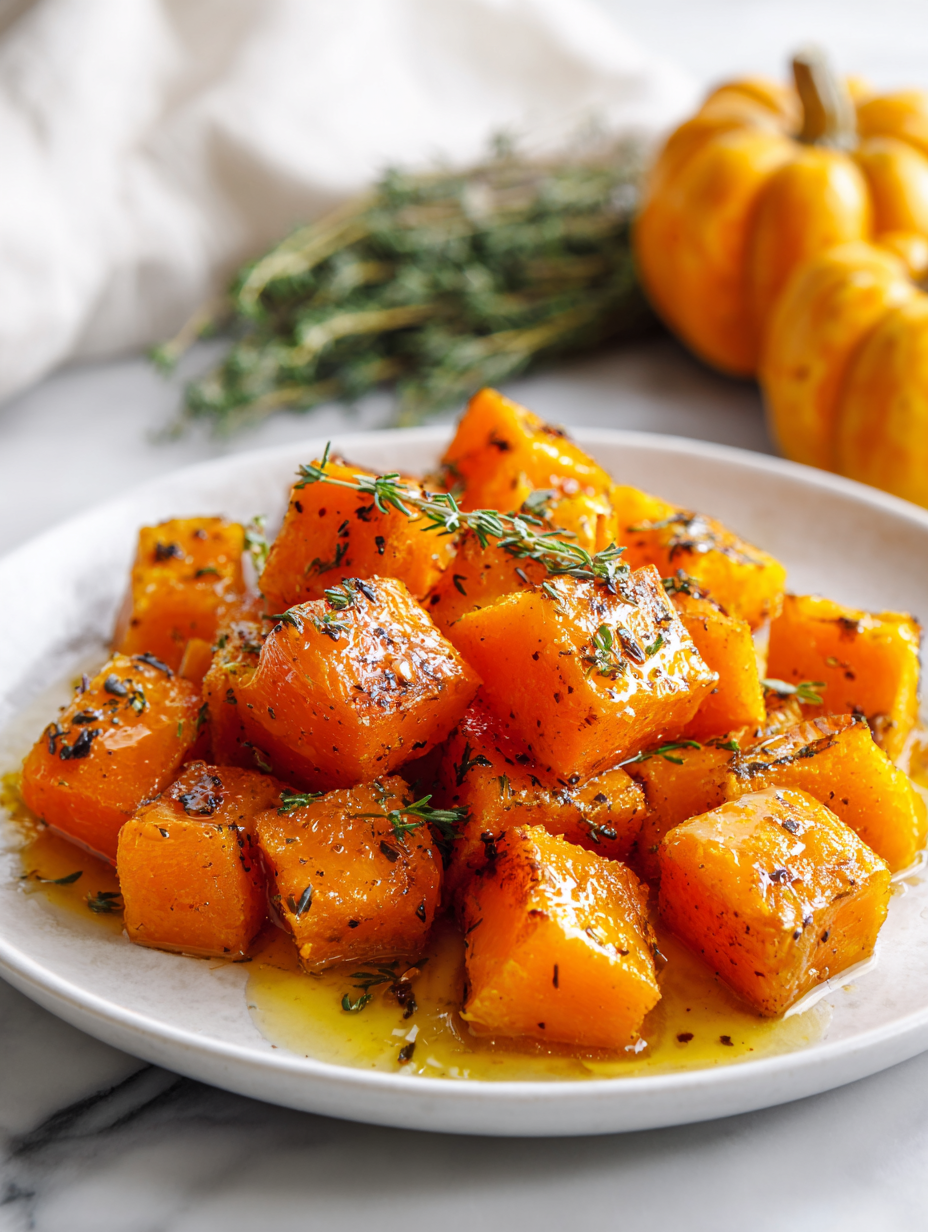
Roasted Butternut Squash with Maple and Thyme
Ingredients
Equipment
Method
- Preheat your oven to 200°C (390°F) and line a baking sheet with parchment paper.
- Using a sharp vegetable peeler, carefully peel the tough skin off the butternut squash until smooth.
- Slice off both ends of the squash, then cut it in half lengthwise. Scoop out the seeds with a spoon.
- Cut the squash into 1-inch cubes, making sure they are as uniform as possible for even roasting.
- In a large bowl, toss the cubes with olive oil, maple syrup, salt, black pepper, and fresh thyme until evenly coated.
- Spread the coated squash cubes on the prepared baking sheet in a single layer, ensuring they aren’t crowded.
- Roast in the oven for about 30-35 minutes, flipping or shaking the pan halfway through, until the edges are golden and caramelized.
- Once roasted, remove from the oven and let the cubes rest for about 5 minutes—this helps them set and enhances flavor.
- Transfer the squash to a serving dish and optionally drizzle with balsamic vinegar for extra smoky tang.
- Serve warm as a side dish, salad ingredient, or hearty addition to grain bowls. Enjoy the sweet, savory, and caramelized flavors!
Cooking checkpoints to keep you on track
- The squash should be tender when pierced with a fork, but still hold shape.
- Edges should be deeply caramelized and slightly crispy.
- The smell of roasted squash should be sweet and smoky, not burnt.
- If the squash releases too much liquid, increase oven temperature slightly.
Common pitfalls and how to fix them
- Dull blades make peeling and cutting dangerous and frustrating.? Use a sharp knife to prevent squashing the squash.
- Uneven roasting if pieces are inconsistent.? Keep squash chunks uniform in size.
- Soggy squash from steaming instead of roasting.? Don’t overcrowd the pan.
- Burnt edges or undercooked centers can ruin the dish.? Watch the oven temperature.
This dish isn’t just about the squash; it’s about those moments when simple ingredients become something unexpectedly comforting. Roasting amplifies the natural sweetness while adding a smoky depth, making it a versatile side or a cozy snack. Feel free to tweak the seasoning—add a touch of chili or a splash of lemon—to make it your own. Just keep it honest, keep it warm, and let the flavors speak.

Hi, I’m Katie Dawson, the owner, cook, and storyteller behind Little More Lovely. I run a small café in a cozy corner of Seattle, where the smell of freshly baked bread meets the hum of neighborhood chatter. I’ve spent years learning how food can bring people together, both as a professional and as someone who loves to share meals with family and friends.